How Hiring Must Change to Reflect the Reality of an AI-Powered BPO Future in India
The mass hiring era is over.
India's BPO sector, valued at around $280 billion, is experiencing its most significant transformation since the Y2K boom, as artificial intelligence fundamentally alters the rules of talent acquisition. The sector is projected to reach $139.35 billion by 2033. (Important note: Market size varies by source, ranging from $49.87 billion to $280 billion, depending on definition and scope. The key takeaway is that the BPO sector in India is substantial, regardless of the methodology.)
Additionally, approximately 3 million Indians work in BPOs providing customer support, software development, accounting, marketing, and other back-office operations for a variety of global clients.
With 45% of non-voice interactions now handled by AI and chatbots, reducing Average Handling Time by 20%, the industry faces a stark reality: traditional volume-based hiring models are becoming obsolete.
The transformation is so compelling that global investment giants are racing to claim their stake. SoftBank Group is actively pursuing buyout deals in India’s IT and BPO companies, specifically targeting firms that can leverage AI capabilities to deliver services more efficiently.
Having previously explored a $1 billion acquisition of BPO firm AGS Health and held discussions with WNS Global, SoftBank is now seeking AI-ready Indian IT firms across financial services, healthcare, and legal sectors.
This investor confidence reflects the sector’s potential to deliver cost efficiencies and revenue growth through AI transformation.
AI=Growth
Yet paradoxically, the AI revolution is driving growth, not decline. The financial performance of major BPO companies demonstrates that AI adoption is creating value rather than destroying it.
For example, TCS grew from $25.0 billion in FY2022 to $29.08 billion in FY2024 while maintaining a healthy 19.3% net margin. Accenture expanded from $61.6 billion to $64.9 billion over the same period, and Genpact achieved 6.5% growth to $4.77 billion in 2024, all aided by AI-driven automation.
Entry-level voice-based support positions face 30% attrition rates, while demand is soaring for AI Coordinators, Process Engineers, and KPO Specialists, who command billing rates of $25-35 per hour, more than double the $12-15 per hour billing rates for traditional voice roles.
The End of "Jobs Everyone Can Get Into"
The democratization of BPO employment is coming to an end. Historically, India’s BPO industry has been a major employer for graduates from arts, commerce, and tier three or four engineering colleges. This landscape is changing quickly as companies shift their hiring strategies from quantity to quality.
EY India’s 2025 report “The AIdea of India” found that among the business processes expected to see the most impact is call center management, which is likely to witness an 80% productivity enhancement, followed by software development with a potential for 61% growth in productivity. Content development and distribution at 45%, customer services at 44%, and sales and marketing at 41% follow.
The report also states that the skills gap is stark, with 97% of executives citing the lack of AI talent as the primary barrier, while only 3% of Indian enterprises possess sufficient in-house AI talent. This scarcity is driving fundamental changes in how BPO companies identify, assess, and onboard talent.
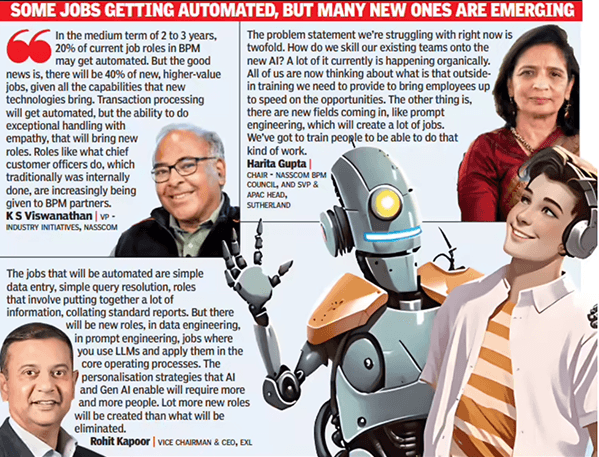
From Language Skills to AI Coordination
The hiring criteria transformation is already underway. Companies are moving beyond traditional language proficiency and basic computer skills to evaluate candidates on AI system management, data interpretation, complex problem-solving, and emotional intelligence for human interactions.
The business case is compelling: leading BPO companies are now working to ensure they thrive in the AI era through strategic workforce transformation. WNS Global Services, despite AI integration across operations, grew revenue from $1.20 billion to $1.31 billion over the past three years while improving net margins to 11.2%. For HCLTech, revenue growth for the full year FY25 was 6.5% to ₹117,055 crore through AI-augmented service delivery.
This shift is reflected in emerging role categories:
AI Coordinators who manage human-AI workflows
Process Engineers combining RPA, analytics, and NLP
Multi-agent Workflow Designers orchestrating complex automated systems
KPO Specialists handling high-value knowledge work requiring AI augmentation
From Volume to Value: What Recruiters Really Want
The recruitment paradigm has fundamentally shifted from casting wide nets to precision targeting. Recent reports confirm a marked shift from volume-based to quality- and skill-based hiring in India’s services sector. LinkedIn’s India Hiring ROI report (June 2025) found that 72% of recruiters now rate “quality of hire” as their most important metric, overtaking time-to-fill as the primary success indicator.
Ruchee Anand, LinkedIn Talent head, observes that recruiters traditionally “cast the net wide but not deep…choosing volume over precision,” but emphasizes that “hiring today demands more”, signaling a decisive move away from indiscriminate mass hiring practices that were common across the board, and, in this case, in the BPO sector, too.
The skills transformation is completely reshaping the expectations of recruiters. In practice, BPO firms are increasingly looking for graduates who possess stronger analytical and technical skills rather than just language proficiency. Industry analysis shows that the old "labor arbitrage" model, which involved hiring any graduate for repetitive tasks, is being replaced by roles that require data analysis and programming skills.
Recruiters themselves are embracing AI-powered hiring strategies. The data shows that nearly 69% of recruiters now use data analytics and 63% use AI tools in their hiring processes, reflecting a strategic shift towards identifying candidates who can work with AI and digital tools rather than be displaced by them.
This technological adoption by recruiters reflects the wider transformation in the industry: companies are looking for candidates who can work alongside AI systems, handle automated workflows, and offer the human insight that machines are unable to replicate. The focus of assessments has transitioned from basic English proficiency and computer skills to the management of AI systems, data interpretation, complex problem-solving, and emotional intelligence for human interactions.
The Human-in-the-Loop Imperative
The most critical finding: humans must remain central to AI-powered operations. NASSCOM’s 2025 Technology Leadership Forum study confirms this trend, noting that “a consistent thread across these efforts is the emphasis on human-in-the-loop systems, which is prompting a reexamination of roles, skills, and job definitions across the BPO workforce. Fully autonomous, end-to-end workflows remain more vision than reality for now.”
TCS developed an AI-driven collaboration suite where AI assistants work with human interviewers in a triangular formation, providing real-time recommendations while reducing decision-making bias. The Infosys Topaz platform combines over 12,000 AI assets with human oversight, processing 20 billion transactions while maintaining principles of being 'responsible by design'.
The performance data supports this approach: while AI systems analyze interactions, human agents offer personalized coaching and manage complex scenarios that require emotional intelligence and creative problem-solving.
Geographic Redistribution and Talent Localization
The tier 2/3 city expansion is accelerating talent decentralization. Geographic expansion to smaller cities is supported by substantial government initiatives, with the IBPS Scheme committing INR 493 crore to create 120,000 jobs across 100+ smaller cities.
Tier-2 cities such as Lucknow and Mangalore are ranked among the top three cities with the most employable talent, according to the India Skills Report 2023. These locations offer a cost of living that is 10-35% lower compared to tier-1 cities, while also exhibiting attrition rates that are up to 10% lower.
Geographic redistribution allows "locally sourced talent with AI augmentation" to perform at levels comparable to those in metropolitan areas, a model that aligns perfectly with AI-enabled work which depends more on cognitive capabilities than on physical proximity to urban centers.
Strategic Imperatives for BPO Hiring Leaders
The transformation demands immediate action across five critical areas:
Redefine job specifications: Move beyond language skills to AI coordination, analytical thinking, and cognitive flexibility
Implement AI-enhanced assessments: Deploy cognitive evaluation platforms that simulate real AI-human collaboration scenarios
Establish continuous learning pathways: Create mandatory upskilling programs with measurable AI competency milestones
Embrace geographic flexibility: Leverage tier 2/3 city talent pools with AI-enabled remote collaboration capabilities
Develop hybrid role architectures: Design positions that optimize human-AI collaboration rather than viewing AI as a replacement
The Future is Now
The evidence is clear: AI is reshaping rather than eliminating BPO employment—and it’s fueling financial growth. The sector’s revenue expansion validates this across both diversified IT services and pure-play BPO companies.
Cognizant maintained resilience through global challenges, reporting $19.7 billion in FY 2024 revenue, and EXL Service, a pure-play analytics and BPO provider, grew from $1.41 billion in 2022 to $1.84 billion in 2024, a 30% increase over three years, with strong operating margins of approximately 14%.
Firstsource grew from ₹5,923 crore to ₹6,336 crore, demonstrating ongoing progress despite disruptions in the industry. Concentrix, through strategic acquisitions and AI-driven service expansion, increased from $7.11 billion in FY 2023 to $9.62 billion in FY 2024.
These results demonstrate that companies that embrace AI-human collaboration are gaining market share, regardless of their business model.
While routine roles are being phased out, new, specialized positions are emerging. The companies that successfully embrace human-AI collaboration, invest in upskilling, and redesign hiring for cognitive and digital capabilities will lead the next phase of India’s BPO evolution.
The era of precision talent acquisition for AI-augmented work has begun.